


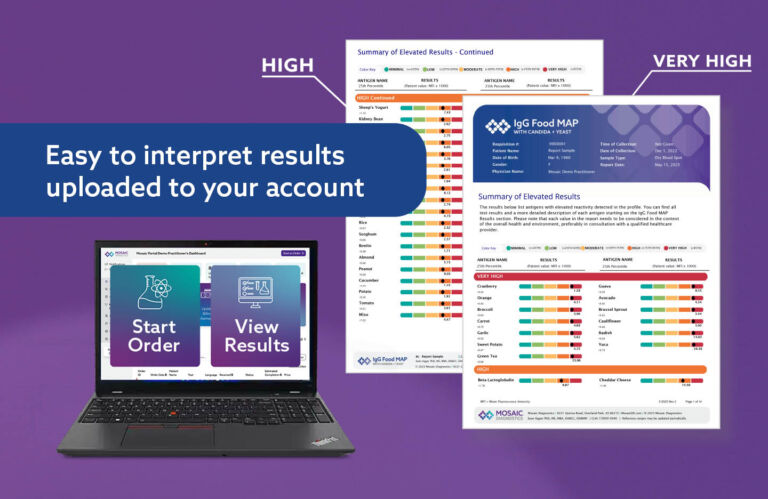


IgG Food MAP with Candida + Yeast (Dried Blood Spot)
$282.00
Redefining the Standard in IgG Food Sensitivity Testing
For over 29 years, Mosaic Diagnostics has exemplified innovation and adaptability in this evolving landscape. Leveraging a robust dataset of 79,000 global samples, we are redefining IgG food sensitivity testing and reporting standards. Our goal is to provide healthcare providers with accurate, representative data that reflects the dietary diversity of today’s population, and our reference ranges align with the varied diets and demographics of the modern world.
IgG food sensitivities provide a useful guide for personalized rotation/elimination diets with clinical impact associated with a variety of diseases. People may continue to eat offending foods, unaware of their potential adverse effects, because symptoms associated with food sensitivities may occur hours or days after the offending food was eaten.
MosaicDX’s IgG Food MAP measures antibodies to common foods, herbs, and spices typically found in Western, Asian, and Mediterranean diets also include results for Candida and Yeast. This test is available in both serum and dried blood spot formats, making it easy and convenient for patients. By identifying food sensitivities, our test will help individuals customize their diet leading to improvements in overall health and wellbeing.
Description
Why Test IgG Antibodies?
IgG food sensitivity testing is a simple and effect way to identify foods that can trigger an inflammatory response. The provided personalized rotation/elimination diet provides an easier and more convenient approach versus removal of all common foods known to cause allergies/sensitivities, which is often time-consuming and laborious.
Addressing identified food sensitivities can be impactful as they often contribute to chronic health issues. Identifying these sensitivities can be crucial to healing the body and relieving unexplained signs and symptoms.
Why does MosaicDX’s IgG Food MAP test for reactions to Candida?
Elevations in IgG antibodies to candida can signal candida overgrowth in the GI tract. Candida overgrowth in the gut can lead to increased intestinal permeability (also referred to as leaky gut), which may allow larger food molecules to pass through the gut lining and trigger an IgG-mediated immune response. Dysbiosis of the gut including candida overgrowth has been associated with the development of leaky gut and in turn, development of leaky gut has been associated clinically with the development of food sensitivities.
Candida overgrowth can cause a wide range of digestive symptoms including bloating, gas, constipation, diarrhea, and abdominal pain. Additional symptoms associated with candida overgrowth include fatigue and weakness, skin and nail infections, oral thrush, brain fog and mood changes, and food cravings.
Addressing candida overgrowth will aid in healing the gut and decreasing food sensitivities. Depending on the levels of candida and the severity of a patient’s symptoms, further testing may be recommended, including Comprehensive Stool Test and/or Organic Acids Test.
What is the difference between food allergy vs. food sensitivity?
While the terms food allergy and food sensitivity are often used interchangeably to describe adverse reactions to food, they are not the same thing.
Food allergies refer to an immune-mediated process that involves the production of IgE antibodies in response to a particular antigen. IgE-mediated reactions are immediate (immediate hypersensitivity or Type 1 hypersensitivity reactions) and can result in a range of symptoms from more mild (e.g., hives, itching, digestive upset) to more significant (e.g., swelling of mucous membranes of the oral mucosa) to severe (life-threatening anaphylaxis).
Food sensitivities refer to a range of symptoms triggered by certain foods that generally tend to be less severe – and not life threatening – and include common complaints such as headaches, digestive upset, skin rashes, and fatigue. One proposed mechanism for the development of food sensitivities relates to the formation of IgG antibodies in response to certain foods which may be assessed on laboratory profiles.
Finally, the term food intolerance has also been used clinically to describe the body’s difficulty digesting or metabolizing a particular food component that results in symptoms such as nausea, bloating, gas, or even diarrhea. Classic examples of a food intolerances include lactose intolerance (due to a lactase enzyme deficiency), fructose intolerance (due to difficulty absorbing fructose) and reactions to certain food chemicals, additives, or preservatives such as histamines or sulfites.
MosaicDX offers patient-friendly sample collection kits that make testing simple. Each kit includes:
- Visual, step-by-step instructions for test preparation and sample collection.
- Personalized shipping cards.
- Pediatric collection bags if needed.
Please Carefully Note Before Placing Your Lab Order
- All lab test sales are final. Once an order is placed, refunds, cancellations, exchanges, and chargebacks are not permitted, except where required by law.
- Lab testing offered through Cellular Advisory is provided for educational and general wellness purposes only. Cellular Advisory does not diagnose, treat, cure, or prevent disease, and lab testing is not a substitute for medical advice, diagnosis, treatment, or care from a licensed healthcare provider. You should consult your qualified healthcare provider regarding any symptoms, medical conditions, medications, lab results, or health-related decisions.
- Cellular Advisory does not participate in, bill, accept assignment from, or coordinate with private insurance plans. We do not provide superbills and are unable to assist with insurance claims, reimbursement requests, or claim resolution related to laboratory testing, consultations, supplements, protocols, or related services.
- Lab kits cannot be shipped to P.O. boxes. Please provide a valid residential or business shipping address at checkout.
- After your lab test order is placed, you are responsible for carefully reviewing all instructions, completing any required sample collection or lab draw, and returning the specimen according to the laboratory’s requirements.
- All laboratory testing is performed by independent third-party laboratories, including but not limited to Mosaic Diagnostics and ZRT Laboratory, when applicable. Cellular Advisory does not operate these laboratories and is not responsible for laboratory processing times, rejected samples, delayed shipments, incomplete submissions, shipping issues, lab portal access, reporting delays, or laboratory-specific requirements.
- Test results, reference ranges, sample requirements, processing timelines, report formats, and interpretation materials are controlled by the applicable laboratory and may vary by lab and test type.
- After your order is completed, you will receive follow-up instructions by email or through the applicable lab portal. Please review those instructions carefully before beginning your test.



Reviews
There are no reviews yet